
- Published
From Understanding to Practice: Building Your Own Atomic Habits — "Atomic Habits" Book Digest (Part 2)
目錄
Note: This post is translated by AI. If you find any unnatural phrasing or errors, please feel free to contact me via email or other channels. Your feedback is appreciated!
Habit change depends on space located, and cues in front.
Four Steps of Habit Functioning — Habit Loop
Let's review "Definition" and "Goal" of habit first 👇
- Definition: So-called habit, is behavior repeated enough times to be automated
- Goal: Solve problems in life with "least energy and effort".
Then specifically, how does "constant repetition" achieve "automation", and further become a habit?
Best way to understand a big theme is to dismantle it!
- Therefore book dismantles habit into four steps, and calls it "Habit Loop". Following uses scrolling phone as example to explain:
- Cue (Something reminds you to do that thing): Reminds you existence of "phone".
- Craving (Inner desire stimulated by cue): Your craving for scrolling phone, more precisely, scrolling phone can make you feel satisfied.
- Response (Thoughts generated or actions taken based on craving): You actually take out phone and start scrolling.
- Reward (Result obtained after responding to craving, taking action): Contacting others, satisfaction from posting updates, gaming experience of mobile games etc.

Four aspects indispensable
- Cue triggers craving, craving stimulates response, response provides reward, reward satisfies craving, looping around, connects with cue again, cycling like this.
- Missing first three steps, behavior won't happen; missing fourth step, behavior won't be repeated
Now we know loop of habit functioning. Following will introduce how we cultivate good habits and eradicate bad habits in each step.
Remember big principle: What we rely on is not willpower, but understanding habits correctly. Before being designed (tempted) by big environment, we design ourselves first.
Law 1 of Building Habits: Make Cue Obvious
Here, we need to establish a concept first: "Motivation is overestimated, environment often more important".
A study mentioned in book also points out: People choose products often not because "what makes" product, but "where is" product.
Habit change depends on space located, and cues in front.
Most common form of change is not internal, but external. We are changed by things around us. Every habit depends on context. And in this, "Visual cue is strongest catalyst for humans".
- Our reliance on vision is far higher than other senses. Creating obvious visual cues can draw your attention to habit you want.
Want to let good habit become a part of life, let cue become a part of environment first
Make sure to make best choice become most obvious. When cue of good habit is right in front of your eyes, making better decision becomes relaxed and natural.
Environment design lets you take back control, become architect of life. Don't be just a customer of world you are in, also become its designer.
Environment is not full of objects, but full of relationships.
Two Most Common Cues: Time and Location
People who make exact plan on when and where to execute a new habit are more likely to really execute.
- Many people think they lack motivation, actually what they lack is clarity.
- Time and location to take action are not always obvious. Some people spent whole life waiting for correct timing to improve self.
- Therefore, book provided simple action mantra as below 👇
Mantra: I will perform "behavior" at "time" in "location".
- Take myself as example. When rushing thesis before, I told myself every day to go to XXX Cafe (Location) to write thesis (Behavior) after leaving company at 7:30 (Time).
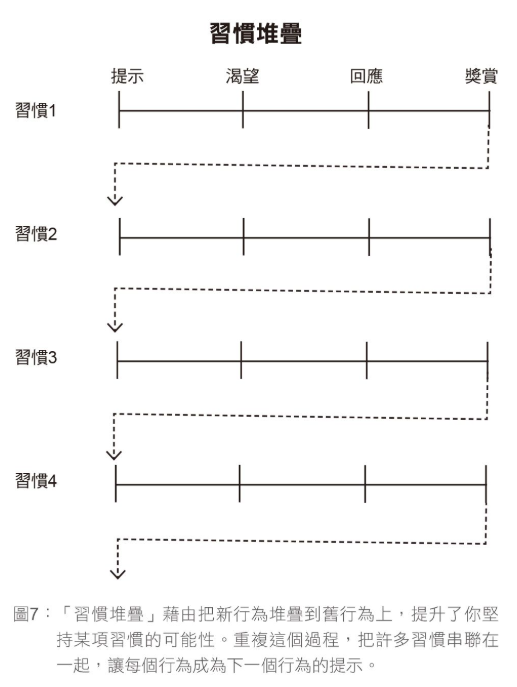
There is another way — "Habit Stacking"
Core concept of this method is "bind wanted behavior with original habit".
Habit stacking allows you to create a set of simple rules guiding future behaviors, as if you always have execution plan for what to do next.
- Book also provided simple mantra 👇
After finishing "current habit", I will execute "new habit".
Basic version: After brushing teeth every morning, I will drink a cup of warm water.
Advanced version (Want to cultivate habit of reading more every night): Wake up → Make bed → Put a book on pillow.
- This way when you want to sleep, book is right on your pillow. Then might as well flip a few pages to read!
Things You Still Need to Know About Cue
1. New environment easier to change habits
Because you don't have to deal with cues of old environment. To change habits in old environment, we must realize old habits first and remind ourselves constantly, then can change habits slowly.
- This is also why we often think moving house, changing job or changing a cafe is a brand new start. Because cues of habits haven't been established in new environment yet. We naturally can re-establish habits.
Want to feel yourself in a new environment, just change layout of furnishings slightly
- Take home as example: Change orientation of desk or bed, you will feel it is a new environment.
- Take phone as example: Periodically change layout of APPs. Flow of you opening phone and clicking APP usually will be disrupted. You will be harder to find commonly used APPs. Can slightly fight against addictive APPs. (I use this to let myself briefly abstain from FB, IG or entertainment APPs)
2. One space, one use
When cues of environment overlap, winner is often easier side.
For example, I wanted to practice "working at home" very much before. But I usually succeeded for a week, but failed for a month. Because space of home for me simultaneously has two uses of "relaxing and slacking" and "working seriously". Predictably I usually chose relaxing and slacking.
- This also explains why many people can only work seriously in library or cafe.
But don't want to go to company on holidays, cafe costs money. Can home only be for relaxing?
Answer is of course Negative. Actually just use habit stacking is fine.
simply put, find out small habit you have every time when working seriously, realize it at home too.
- For example, you wear formal suit when working. Wearing formal suit is your small habit when serious. Then when you want to work at home, also put on formal suit. You will naturally have a feeling wanting to work well. Following this feeling, as long as wearing formal suit at home you can work well.
- Method is of course not limited to this one. You can discover your own serious small habit yourself.
What if no serious small habit? Then cultivate a habit.
For me, it is my small wooden table.
- Whenever I want to work seriously at home, will take out small wooden table. As long as wooden table appears, tell myself now want to work seriously. And when I put away wooden table, it is to relax well. At beginning might still be a bit relaxed, but over time, when taking out wooden table, I can naturally enter serious state.
Digital space is also space
Besides physical space, for modern people, space of phone, tablet, computer also must be managed seriously. Because they already occupied too much time of our lives.
Here I want to speak on a practical case: "Alarm".
Emphasize again: We expect a thing to be multi-functional. The most used is often easier function, not function we need at that moment.
Phone has alarm function yes. But it also has social media, manga reader, NETFLIX. Therefore every time after we set alarm before sleep, we just will open other APPs to scroll again. This scrolling starts from half an hour. We thus sleep late for half an hour. Same when waking up. After we turn off alarm, will also lie in bed continue scrolling. Finally go out only when almost late.
- Therefore, here I suggest everyone not to bring phone into room. Change alarm to use "Physical one". Want to scroll phone, leave bed then scroll.
Reverse of Law 1: Make Cue Invisible
Once habit is established, as long as cue in environment appears again, craving for action follows
If cue is not handled carefully, will instead trigger behavior you want to stop.
Bad habit is self-catalyzing. Bad habit promotes emotions it attempts to numb.
- Crazy binge-watching makes you lethargic, spent too much time again. But you continue watching because having no time and energy to do other things.
- You are anxious because smoking is harmful to health. But seeing disgusting photo on cigarette pack generates more anxiety. Thus smoked another cigarette to relieve anxiety.
Cue triggers craving
An external stimulus caused a compulsive craving wanting to repeat bad habit. Once noticed something, you start to want.
One of most practical ways to eliminate a bad habit is to reduce exposure to cues stimulating this bad habit.
- Like binge-watching: Don't install drama watching APP in phone. Don't put in web bookmarks, favorites.
Here also provide my method:
- Because I bought a tablet, so I installed all entertainment APPs (Manga reader, Animation crazy) on tablet. Therefore tablet became a hint for binge-watching. I can only binge-watch when picking it up. Rest of time is focusing on doing current things.
- And if no tablet, might consider using bookmarks of another browser. Like Safari bookmarks put entertainment webpages, Google Chrome put practical webpages.
Secret of Self-control
In short term, you can use willpower to overpower temptation; In long run, we remain product of environment we live in.
Author in book said more bluntly, I haven't seen anyone can always maintain positive habits in negative environment.
- Self-control is a short-term strategy, not applicable to long term. You might be able to resist temptation once or twice, but unlikely to let willpower override desire every time. Rather than drumming up willpower every time wanting to do right thing, better use energy to optimize environment located.
This is secret of self-control: Make cues of good habits obvious, make cues of bad habits invisible.
Conclusion
Want to make behavior stable and predictable, need stable and predictable environment.
As psychologist Jung said:
"Until you make the unconscious conscious, it will direct your life and you will call it fate."
- There are too many things we do subconsciously in our daily life. Those things are our daily habits. And these habits are often just result of environment.
- Take scrolling phone as example: You put phone in pocket, on table or any place you can see. It being there itself equals to a hint calling to go scroll phone.
Following are Law 2~4. But considering hoping length of one article not too long, also let everyone do not practice too many methods at once. Finishing talking about cue this time, can start improving own habits from this part of cue first. Step by step gradually. Please go to book to explore remaining parts readers!