
BLUE GIANT
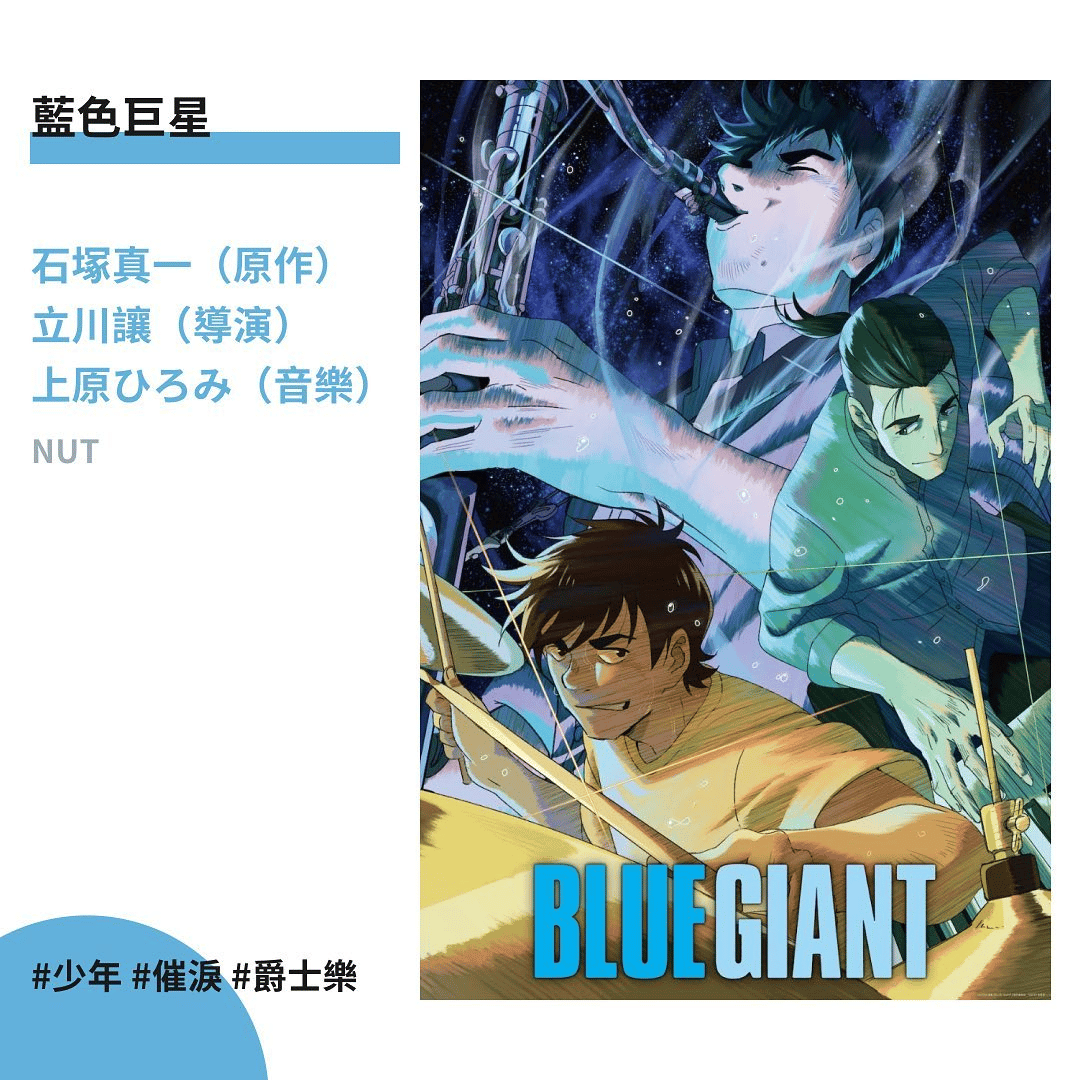
I originally wrote this on IG. I’ve archived it here, keeping it as close to the original as possible.
A blue giant is a giant star that burns hotter than a red giant and shines blue.
The film pairs lively jazz with images that make the music as much a feast for the eyes as for the ears. It goes further than that, working the pain, uncertainty, and growth of three young musicians into the way it shows us jazz.
The Story
It gets straight to the point: the passion for jazz and the mindsets of three people at different stages, working toward different things. The manga has more room for their inner lives and the details of how things work in the real world. The film has a simpler job and sticks to it.
The film follows three eighteen-year-olds: Yukinori Sawabe, a pianist who's played since he was four, Dai Miyamoto, a talented and hardworking tenor saxophonist, and Shunji Tamada, who takes up the drums because of Dai.
The three make up JASS, a piano, sax, and drum trio. Dai wants to be the best in the world. Yukinori wants to revive jazz. Shunji is simply drawn to them, moved by their jazz, and wants to play with them.
We get to see how jazz becomes a way for each of them to express and understand himself.
The film gives the audience real attention too. After all, a performance takes more than performers. BLUE GIANT lets you see the part different listeners play as the musicians grow.
The thoughts below on Yukinori and Shunji's growth contain spoilers!
Yukinori
He's played piano since he was little and put in years of work. His confidence in his ability feels perfectly natural to the other characters and the audience. You hardly notice that it has slipped over into arrogance and contempt for other people.
The person who runs So Blue, Japan's top jazz venue, calls him on it the first time they meet. It lands like a slap for both Yukinori and the audience.
He's shaken, but he accepts it almost immediately. His passion for So Blue and his belief in jazz are real. Because he loves it that much, pride isn't worth holding on to if it gets in the way of getting better. If his attitude is the problem, he'll work on it. What matters is taking his jazz further.
His first step is to find a fan he'd been rude to, apologize, and sincerely invite him to keep coming to their shows. There's something lovely about how honestly he does it.
His attitude is one problem. The other is how cautiously he plays. He won't let himself go onstage, and a performance like that can't move anyone. He may be young and hardworking and talented, but holding something back shows a lack of respect for the others working in jazz, for the audience, and for himself. Maybe he's afraid of making a mistake or finding out he can't carry it. Still, he's already taken a wrong step by refusing to try and show what he's got. Playing safe won't get him where he wants to go. Thinking he can make history with that halfhearted approach is its own kind of arrogance.
Yukinori realizes it right away. Realizing you need to change and actually changing are two different things. He hits a wall.
No matter how many things he tries or how much effort he puts in, he can't get out of his comfort zone.
When he opens up to Dai and Shunji, Dai tells him:
“No matter how awful I sound, every second I have that sax in my hands, I believe I'm the best in the world.”
“If the person who runs So Blue thinks you stink and you agree, you're finished.”
Dai has always believed in his own jazz and in his ability to move people with it.
Yukinori, at this point, doesn't believe in himself. It's hard to move anyone when you can't even trust yourself.
What he's missing is courage, confidence, and love. That feels very real to me. Once you've built up some skill and put in the work, what's left can be exactly what keeps you stuck.
What finally changes him is seeing Dai's daily practice by the river and getting an unexpected chance to play with a well-known jazz group. He comes to understand how to live with the music he loves: just play. Take pleasure in his own jazz, and put all those years of practice and love into the performance. While he's playing, the film gives us the years of practice at the piano and the moment that first brought him to jazz. The images do the work beautifully.
Shunji
Shunji used to feel that way about soccer. Something an older player said made him realize the other guys in the club were just there to mess around. That was hardly what he wanted to give his youth to.
You might never play soccer or jazz again after this. That's no reason to give it half your attention now.
What Shunji longs for is to take something seriously and really work at it.
So on the night he quits the club, he goes to the riverbank. Dai's love of jazz comes through so strongly that he gets drawn in and plunges headfirst into it.
I understand that pull. I know people who have something they love and give themselves to completely. There's a brightness about people who live that way.
The Audience
And finally, the audience!
I liked the two people who kept coming after the first show. One was a passing office worker who'd barely been interested in listening, but was so moved by the performance that he became a regular. The other was an older man who enjoyed hearing Shunji get better as a drummer.
There's also the bar owner whose faith in jazz becomes faith in JASS, Yukinori's childhood friend, and Dai's brother.
I loved that the film went out of its way to show us a little of who these listeners are.
I already liked the adaptation this much. Now I want to read the manga and see what other sides of the characters it has room for.
support
Give me a Boba!
Thank you for arriving at my web 🕸️ in a time when attention is precious. If this visit felt worthwhile, buying me a boba would mean a lot!